

Table of Contents[Hide][Show]
Spirit is one of the most-searched airlines for “hubs,” but it doesn’t operate a traditional legacy-style hub-and-spoke network like Delta, United, or American. For Spirit, it’s more helpful to think in terms of crew bases and key operating airports—because those are the places where Spirit typically has the most flights, the most route options, and the best chance of finding a same-day alternative when things change. This is similar to the model used by Southwest Airlines.
If you want to compare Spirit’s network style to other U.S. airlines, start with our complete list of airline hubs in the United States.
Quick answer: the closest thing Spirit has to “hubs”
For travelers, Spirit’s “hub-like” airports usually overlap with where the airline has crew bases and a consistently large schedule. These are often the best places to connect (or recover from disruptions) because there are simply more flights to work with.
Hub vs. focus city vs. crew base (plain English)
A quick translation of the terms you’ll see online:
Hub (legacy airlines): Built for connections, with banks of arrivals/departures.
Focus city: An airport with a large schedule presence, but not necessarily built around connections.
Crew base: Where crews are assigned to start/end trips. For many low-cost carriers, crew bases are often the most practical indicator of where the airline is operationally strongest.
Spirit Airlines crew bases (the best “hub” proxy)
Spirit lists crew bases in the following airports (this is the most useful starting point if you’re trying to figure out where Spirit has depth):
| Spirit crew base airport | Code | Why it matters to travelers |
|---|---|---|
| Atlanta | ATL | Big network coverage + frequent departures |
| Dallas/Fort Worth | DFW | Strong for Texas and many one-stop routings |
| Detroit | DTW | Important Midwest anchor |
| Fort Lauderdale | FLL | Core Florida/South network + lots of frequency |
| Houston–Intercontinental | IAH | Strong for Texas and select international/leisure routes |
| Las Vegas | LAS | Strong for the West and leisure-heavy flying |
| Orlando | MCO | One of Spirit’s most schedule-dense airports |
| Miami | MIA | South Florida coverage (often paired with FLL) |
| Chicago–O’Hare | ORD | Strong Midwest connectivity + frequency |
Spirit’s most “hub-like” airports for connections
If you’re building an itinerary with a connection (or you want the best odds of a same-day backup flight), these are typically the most practical Spirit airports to route through:
Fort Lauderdale (FLL) and Orlando (MCO) are often the easiest starting points for Florida-heavy and Caribbean-adjacent trips because Spirit tends to run dense schedules there.
Las Vegas (LAS) is frequently the simplest connect-through option for West and Mountain-region routes.
Dallas/Fort Worth (DFW) and Houston (IAH) can work well for Texas and for certain one-stop combinations that would otherwise require awkward backtracking.
Detroit (DTW) and Chicago O’Hare (ORD) are commonly the cleanest Midwest connection points when Spirit’s schedule supports it.
Because Spirit adjusts routes more aggressively than legacy carriers, it’s always smart to confirm what’s currently operating using Spirit’s route map before you commit to a tight connection.
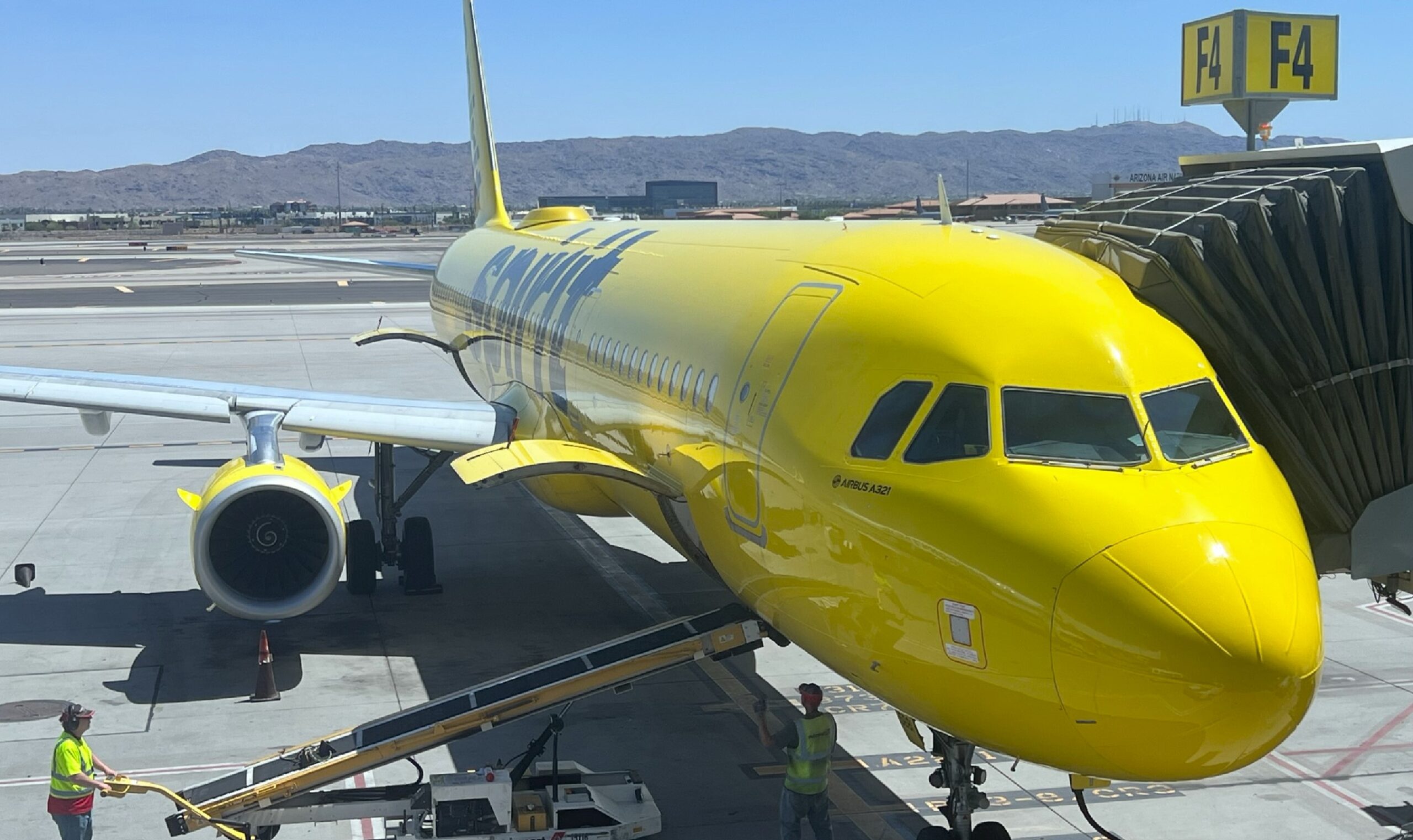
Which Spirit airport should you connect through?
The “best” Spirit connection is the one that gives you the most same-day options on your specific legs. A few reliable rules of thumb help narrow it down quickly.
If you’re heading to Florida or the Caribbean
When we’re traveling Florida-heavy (or looking at routes that lean Caribbean), we usually start by checking routings through airports where Spirit tends to run the densest schedules in that region. More daily flights is the best hedge against delays, missed connections, or last-minute rebooking surprises.
If you’re heading West
For West Coast and Mountain-region trips, we look for itineraries that connect through Spirit airports that consistently support high-frequency leisure flying. These routings often produce more “normal” one-stop options and less backtracking than trying to force a connection through a small station.
If you’re heading Midwest / Great Lakes
For Midwest connections, Spirit itineraries are usually easiest when you connect through one of the airline’s stronger Midwest anchors. The practical advantage is simple: better schedule depth tends to mean more fallback options if you need to move flights on the same day.
If you’re traveling Texas-heavy
For Texas-heavy itineraries, it’s often simplest to route through Spirit’s biggest Texas-area operating airports so you have more departure waves to choose from. This can be especially useful if you’re trying to protect an evening arrival or a time-sensitive event.
Booking tips that matter more on Spirit than on legacy airlines
Spirit trips can go smoothly, but the margin for error is smaller—mostly because fees, tight schedules, and limited fallback options can compound quickly.
Protect your connection time (and your wallet)
If there’s one place we avoid “optimizing” too hard, it’s a tight Spirit connection. When Spirit has fewer later flights on the same route, a small delay can turn into a long day. Before booking, it’s also worth reviewing our Spirit carry-on rules guide so you don’t get surprised by bag fees at the airport.
Know what Spirit will do during delays and cancellations
When flights get delayed or canceled, the playbook is different on U.S. airlines than many travelers expect. We recommend skimming our Spirit flight delay and cancellation guide so you know what to ask for and what’s realistic to expect when schedules break.
If you’re planning same-day changes, understand standby first
Spirit handles standby and same-day changes very differently than airlines that offer broad free standby. If you think you might want to move to an earlier flight—or you’re trying to understand what happens if you misconnect—read our Spirit standby guide before you travel.
When it’s better to take a refund than rebook
If Spirit cancels your flight or makes a significant change, the biggest decision is whether to rebook or take the money. We typically start with our Spirit refund guide, and then use our airline ticket refund rules guide as the broader reference for how DOT rules work across U.S. carriers.
Frequently Asked Questions
Not in the traditional “hub-and-spoke” sense. For most travelers, Spirit’s crew bases and its largest operating airports serve as the closest equivalents because they tend to offer the most route options and the best same-day fallback options.
Spirit does not publish a single official “biggest hub.” In practice, the most “hub-like” airports are usually the ones where Spirit runs the densest schedules and maintains a large operational footprint—especially in Florida and major leisure markets.
Spirit is primarily point-to-point, but many itineraries still connect through larger Spirit airports because that’s where route combinations are most available.

Tim White is the founder of milepro.com, a luxury travel resource featured in CNBC, Travel & Leisure, and other major media outlets. With over 2 million miles flown and 30+ years of business travel experience, he holds Hyatt Globalist, Marriott Lifetime Titanium, and Hilton Diamond status — and has spent years decoding the world of luxury hotel programs, preferred partner benefits, and miles & points optimization so you don’t have to.
 Southwest Airlines Hubs: Does Southwest Have Hubs (or Just Focus Cities)?
Leave a Reply